The Most Peculiar Signature in Recorded History
Christopher Columbus · 1492–1506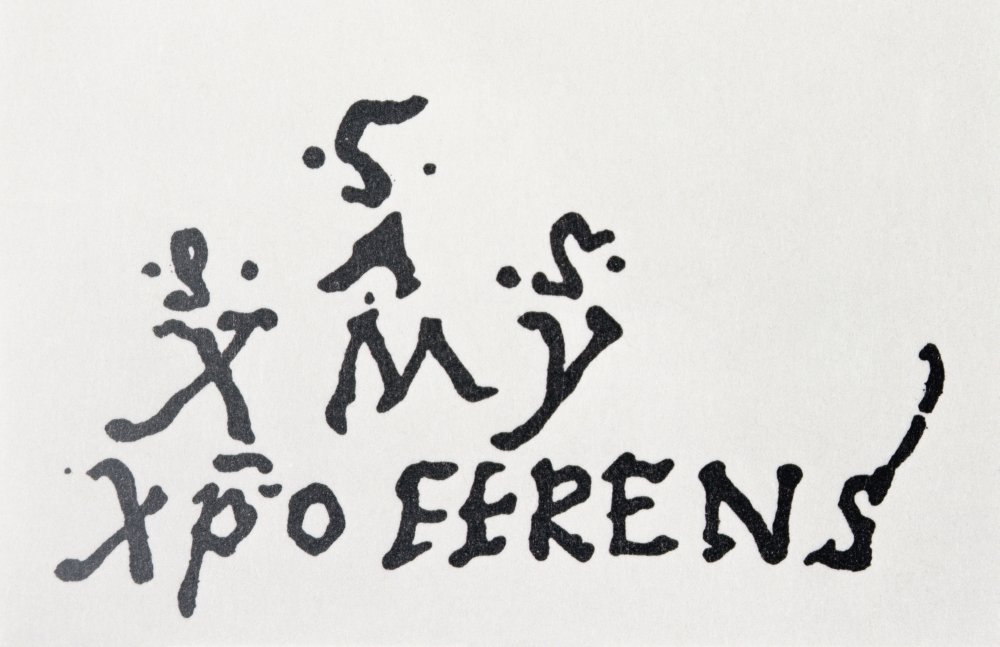
There are a handful of famous signatures through history — Marilyn Monroe, John Hancock, Vincent Price, Beyoncé, Emily Dickinson, to name a few. But none are as bizarre as Christopher Columbus’s, which he created at some point during his 1492 voyage and began using after returning to Europe. In the novel, I placed its creation during the month he was anchored in the Canary Islands, though no documentary evidence establishes exactly when he devised it. Extended periods at anchor during repair or provisioning would have provided intervals of relative stillness not available during active ocean passage, when navigation, maintenance, and weather demanded continual attention.
Although Columbus never explained what the signature meant, he signed nearly everything with it until his death in 1506, and explicitly instructed his heirs to continue using this exact format in perpetuity — a directive preserved in his will.
The meaning has been the subject of sustained scholarly debate. Interpretations have ranged from Trinitarian symbolism (“Sanctus, Sanctus, Sanctus”) to devotional formulations such as “Servus Sum Altissimi Salvatoris,” to Christological constructions linking the Greek abbreviation “Xpo” (for Christos) with the Latin ferens (“bearer”), reflecting the etymological meaning of “Christopher” as “Christ-bearer.” Some scholars emphasize theological structure; others view it as personal piety intertwined with his self-understanding as a divinely appointed admiral.
Deep contextual framing of who Columbus was — some obvious, some not — helps explain not just the what, but the why behind his signature. Respectfully, I cannot share all of this analysis until after Book Three is published. In general, I have leaned toward more complex explanations because they are consistent with the disguised symbology Columbus employed in letters written after the 1492 voyage, which varied depending on the recipient.
Based on an understanding of the complicated man, it leads me to the following interpretation.
The Author’s Interpretation
What the Signature Means — Layer by Layer
The first meaning is drawn from Latin and Italian: Servus. Sum. Altissimo. Salvator. This is almost universally agreed upon by scholars and translates as “Most exalted Savior, I am thy servant.”
The three S’s also stand for Sanctus. Sanctus. Sanctus. In Latin: “Holy, Holy, Holy.” That leaves the A in the middle, where Columbus placed himself — the A representing him as an Admiral in Spanish, Italian, and Portuguese. The fact that admiral is the same in all three languages is significant: Columbus was deliberately vague about his origins, and this allowed him to continue that vagueness without being overtly deceitful.
The X stands for Xristos — Christ’s name in Greek. M is for the Virgin Maria in Spanish. The Y almost certainly stands for Yesus — the Hebrew rendering of Jesus. In a period of heightened antisemitism across Europe, Christ’s Jewish origins were nonetheless theological common ground, and this use of Hebrew would have struck contemporaries as historically accurate devotion rather than anything broader.
Xpo in Greek means Christ. Ferens in Latin means to bear. For a scholar of languages, this denotes a “porter of Christ” — which Columbus claimed and strove to be.
Columbus embedded meaning into this signature at multiple registers simultaneously — theological, linguistic, personal. A man who spent his life managing what others knew about him designed a signature with layers, while reserving the right to choose who he invited into each level of meaning. The full accounting will have to wait for Book Three.
Sources & Further Reading
- Christian History Institute — Columbus’s Signature
- Mysterious Writings — Unsolved Code: The Signature of Christopher Columbus