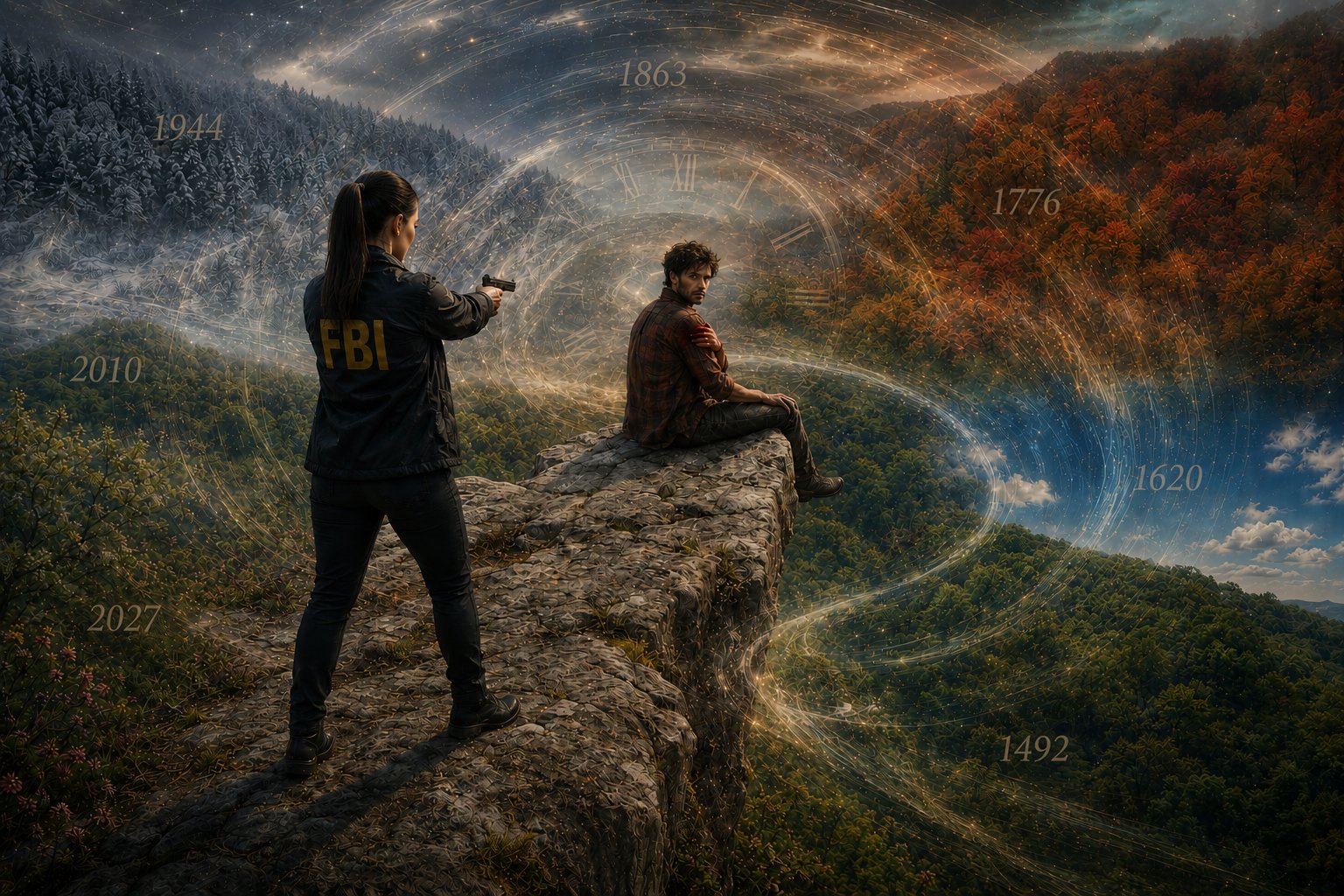
Let's discuss one of the most successful and yet niche genres of fiction. In homage to the genre, let me answer that later. Can you guess it from these NYT bestsellers?
- The Time Traveler's Wife by Audrey Niffenegger
- 11/22/63 by Stephen King
- Outlander by Diana Gabaldon
- The Midnight Library by Matt Haig
- One Italian Summer by Rebecca Serle
- Yesteryear by Caro Claire Burke
If that wasn't enough, how about these Emmy and Golden Globe winners and nominees?
- Quantum Leap — a five-time Emmy Award-winning series
- The Twilight Zone — created by Emmy Award-winner Rod Serling, with 150+ episodes
- Outlander — Golden Globe nominated, massive cultural phenomenon
- Dark — critically acclaimed, strong awards presence in international categories
- Futurama — won an Emmy for the episode "Roswell That Ends Well"
- The Time Tunnel — a forgotten classic from 1966 that won an Emmy
And honorable mention goes to Timeless — it never won an award, hence the honorable mention, but when NBC cancelled it after one season, the fan backlash was so strong that NBC reversed course and made a second season that earned a 100% rating on Rotten Tomatoes.
My last clue: blockbuster films in this genre include Back to the Future I, II and III, Terminator and its sequels, Groundhog Day, The Time Machine, Interstellar, Edge of Tomorrow, Midnight in Paris, Looper, Primer, The Girl Who Leapt Through Time, Harry Potter and the Prisoner of Azkaban, Avengers: Endgame, Frequency, About Time, and Somewhere in Time.
I am sure by now you've put it together. The genre in question is time travel.
A tiny fraction of all fiction — yet impossible to ignore
Despite the success catalogued above across mediums, time travel represents a tiny fraction of all fiction and is not something most movie producers, publishers, or literary agents are actively seeking — despite the fact that no other single speculative device stretches across as many genres successfully. Part of the problem is precisely this: time travel can be characterized as historical fiction, speculative fiction, science fiction, romance, thriller, and YA, meaning it doesn't even have a home in any single fiction category. I estimate that time travel accounts for 0.2% of fiction or less, and yet time travel stories have been so wildly successful that nearly everyone has read or seen a fictional story involving time travel and remembers it. Time travel is memorable and prominent.
Why time travel fiction is rare
There are three reasons I believe time travel is not more common in fiction:
- It demands logical accountability. Writing time travel is highly speculative, but requires a logical accountability that other fiction doesn't. Readers will accept a dragon defying the laws of physics — I mean, how heavy is the average dragon in a movie with small wings that somehow flies? However, they will not accept a time travel paradox that contradicts itself.
- It is genuinely hard to make feel real. Every aspect has to feel realistic even when it is not. That tension between speculation and realism is unforgiving.
- It requires operating at scale. Time travel inherently requires a larger-scale story, and many writers work at a smaller scale — following the life of a family or two lovers, for example. Time travel doesn't just require writing at a larger scale; it requires the creation of two or more fully realized worlds at that scale.
In sum, time travel self-selects for ambitious, big-picture-minded authors who can balance high degrees of speculation and realism.
The eight questions every time travel story must answer
No book, TV show, or film could possibly cover all the aspects of time travel. But every story that uses it must reckon with some version of these eight questions:
- How did the capability to travel through time originate?
- How was the capability discovered?
- Who can time travel?
- What does experiencing time travel feel like?
- What is the frequency of time travel — is it a one-time event, or can one go back and forth?
- Is time travel controllable as to when it occurs, or does it happen to a character?
- Can a traveler return, or is it a one-way ticket?
- What changes to history, the universe, or the space-time continuum occur as a result?
Each of these is a fascinating topic that creates rich potential depth of scenery, plot mechanics, and plot twists.
How I approached it in the AMERICA Series
Like other authors writing time travel, I had to focus on a subset of these questions in order to use time travel as a plot element rather than making it the plot itself. In What Must Be Stopped, the first book in the AMERICA Series, I focus on questions 4 and 8. Like almost every story involving time travel, I also had to answer questions 5, 6, and 7 implicitly. I withhold answers to questions 1, 2, and 3.
Question 8 — what changes to history occur — is what makes the AMERICA Series come alive and creates an entire series of immersive historical fiction. Read the books to experience it.
Answering question 4 — what does time travel feel like — occurs in just one chapter, and it is a scene I wrote and revised over an eight-year timeframe. I found it genuinely difficult to describe time travel well, because it requires such a high degree of simultaneous speculation and realism. I used the sense of smell and the feeling of changing temperature to create realism. Even the highly speculative experience of time travel was grounded in tangible detail — such as seeing graffiti disappear because the time travel took the traveler back to before the graffiti was created.
It has been a hard but enjoyable journey becoming a time travel author. What do you enjoy — or not enjoy — about time travel fiction?